
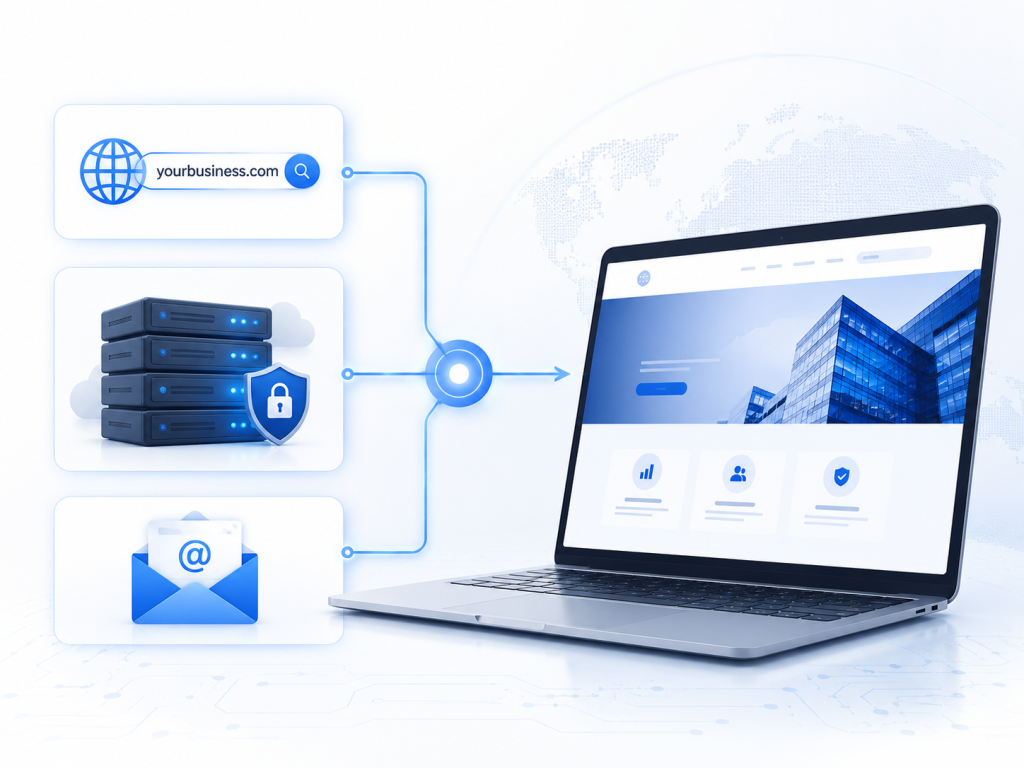
When you run a business online, you often hear the words “domain”, “hosting”, and “email” used together. They are closely connected, but they’re not the same thing. Understanding the difference between your domain, hosting, and email can help you make better decisions, avoid downtime, and know what to check when something stops working.
For many business owners, these services are simply part of “the website” or “the email setup”, and that is completely understandable. You don’t need to become a technical expert, but it does help to know what each part does and how they work together.
At Padroni, we believe in web hosting simplified. That means making the technical side easier to understand so your business can stay connected online.
What is a domain?
Your domain is your online address.
For example, a domain could look like this:
yourbusiness.co.za
or
yourbusiness.com
It’s the name people type into their browser to find your website. It’s also usually the part that appears after the @ symbol in your business email address.
For example:
info@yourbusiness.co.za
In simple terms, your domain is your business’s address on the internet. It doesn’t contain your website on its own, and it doesn’t automatically create email accounts. It simply gives people and systems a way to find the correct online location.
This is why domain management is important. If a domain expires, is transferred incorrectly, or has incorrect DNS settings, it can affect your website, email, or both.

What is web hosting?
If your domain is your online address, your web hosting is the place where your website lives.
Hosting is the server space where your website files, images, databases, emails, and other website content are stored. When someone types your domain name into their browser, the domain points them to the hosting server where your website is located.
For example, when someone visits your website, the process looks something like this:
They type in your domain.
The domain uses DNS to find your hosting server.
The hosting server loads your website for the visitor.
Your hosting package can affect how much storage you have, how your website performs, how many resources are available, and what features you can use. For WordPress websites, hosting is especially important because they often rely on databases, plugins, themes, security settings, backups, and regular maintenance.
With Padroni hosting packages, email accounts and the basic setup thereof are also included, helping you manage your website and email from one connected hosting environment. This makes it easier to keep the key parts of your online presence working together.
Good hosting is not only about having space online. It’s about reliability, support, correct setup, and keeping your website accessible when clients need it.

What about email?
Email allows you to send and receive emails using your own domain name.
For example:
info@yourbusiness.co.za
accounts@yourbusiness.co.za
sales@yourbusiness.co.za
This looks more professional than using a general email address such as Gmail or Yahoo for business communication.
Emails can be hosted in different ways. In some cases, email is included with your hosting package. In other cases, your email may be handled through a separate service such as Microsoft 365, Google Workspace, or another mail provider.
This is where things can become confusing. Your website and email may use the same domain, but they don’t always live in the same place.
Your website may be hosted by one provider, while your email is hosted elsewhere. As long as the DNS records are set up correctly, this can work perfectly. If the DNS records are changed incorrectly, your website may still work, but your email may stop working, or vice versa.
With Padroni hosting packages, email accounts and the basic setup thereof are also included, helping you manage your website and email from one connected hosting environment. This makes it easier to keep the key parts of your online presence working together.

How do domain, hosting, and email work together?
Your domain, hosting, and email are separate services, but they are connected through DNS.
DNS stands for Domain Name System. It tells internet systems where to send website visitors and where to deliver emails.
A simple way to think of it is this:
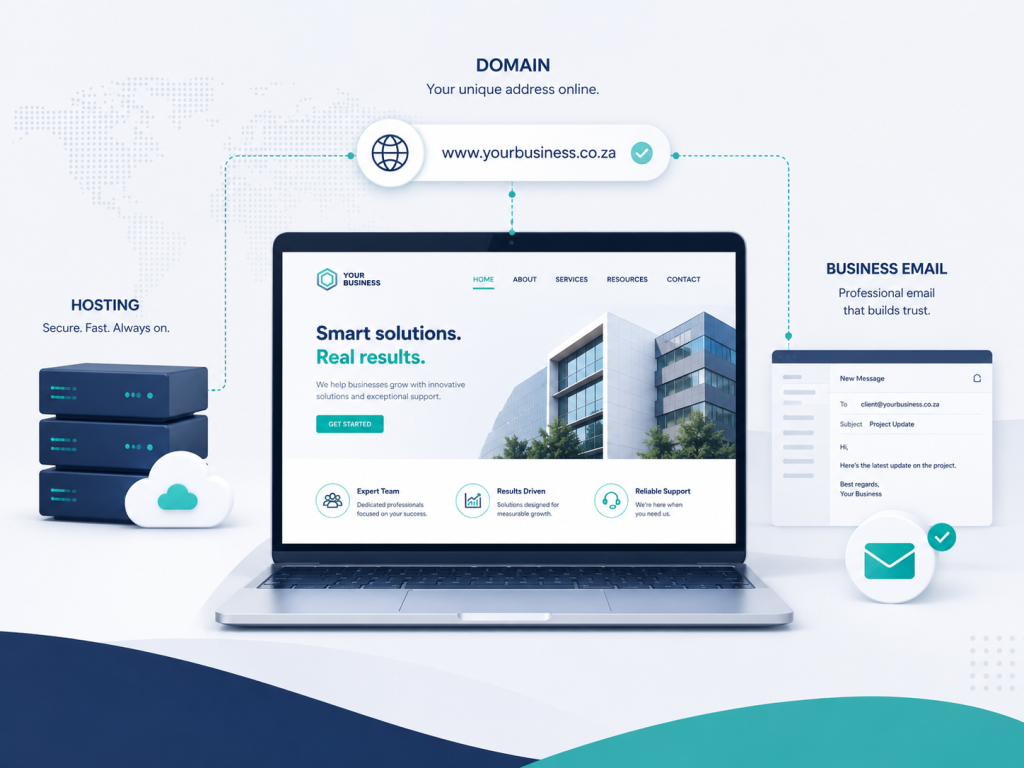
Your domain is your address.
Your hosting is where your website lives.
Your email service is where your emails are handled.
Your DNS records are the directions that connect everything.
If those directions are correct, your website and email work as expected. If they are incorrect, visitors may not reach your website, emails may bounce, or messages may not arrive.
This is why DNS changes should always be handled carefully, especially during website moves, domain transfers, email migrations, or hosting changes.

Why business owners should understand the difference
You don’t need to manage every technical detail yourself, but understanding the basics can help you avoid unnecessary stress.
For example, if your website is down, the problem might not be the website itself. It could be related to hosting, DNS, SSL, a domain expiry, or a server issue.
If your emails aren’t working, the problem might not be your email password. It could be related to mailbox storage, DNS records, mail routing, SPF, DKIM, DMARC, or the email service provider.
If your domain expires, both your website and email may be affected, even if your hosting account is still active.
Knowing the difference helps you ask the right questions and gives your support provider a clearer starting point.
Common situations where this matters
One of the most common examples is a website migration. A business may move its website to a new hosting server, but the email must remain where it is. In that case, only the website-related DNS records should change. If the email records are changed by mistake, email delivery can be interrupted.
Another example is a domain transfer. Moving a domain from one registrar to another doesn’t automatically move the website or email. The domain is only the address. The hosting and email still need to be checked separately.
A third example is setting up a new business email address. Creating an email account is only one part of the process. The correct mail records, authentication records, and device settings may also be needed to ensure messages are sent and received properly.
These situations are not unusual. They are part of normal online business operations, but they do need to be managed correctly.
What should your business keep track of?
Every business should know a few basic details about its online setup.
You should know where your domain is registered, when it renews, where your website is hosted, who manages your DNS records, and where your email is hosted. It is also useful to know who has access to your website admin area, hosting control panel, and domain management account.
This information becomes very important when something needs to be changed, renewed, transferred, restored, or repaired.
When businesses don’t know who controls their domain, hosting, or email, simple changes can quickly become complicated.
Why this matters for business continuity
Your website and email are not just technical services; they’re part of how your business operates.
Your website helps people find you, understand what you offer, and contact you. Your email is often used for quotes, invoices, bookings, support requests, supplier communication, and client records. Your domain connects your business identity to both of these.
If one part stops working, it can affect enquiries, communication, trust, and daily operations.
That is why it’s worth treating your domain, hosting, and email as important business assets rather than one-off setup items.
How Padroni can help
Padroni assists businesses with reliable web hosting, domain registration and management, business email support, DNS assistance, WordPress website support, website design, and technical guidance.
Our goal is to make the technical side easier to understand and easier to manage. Whether you need help choosing a hosting package, managing a domain, setting up business email, checking DNS records, or understanding why something is not working, Padroni provides practical support without unnecessary confusion.
Your domain, hosting, and email work together, but they each play a different role.
Once you understand that, it becomes much easier to see why changes to one part can affect the others. If you need help with hosting, domains, email, DNS, or website support, speak to us. We are ready to assist with practical guidance and reliable online support to keep your business connected.